---
title: "1. Before you Apply"
type: "wiki"
space: "I am an international student"
author: "Heather MacIntyre"
created: 2024-03-12T15:41:42Z
updated: 2026-08-31T08:23:07Z
tags: ["initial-study-permits"]
url: "https://students.senecapolytechnic.ca/spaces/96/i-am-an-international-student/wiki/view/13651/1-before-you-apply"
---
# 1. Before you Apply
A study permit allows you to stay and study in Canada. Most programs that are longer than six months require a study permit and supporting documents. Since processing times can take several months, it’s a good idea to start preparing your application as early as possible. The information below covers eligibility, fees, application and processing times, and required documents.
## Table of Contents
- Who needs a study permit?
- Fees
- Application and processing times
- Checklist
- Required Documents
- Letter of Acceptance \(LOA\)
- Tuition payment receipt
- Provincial Attestation Letter \(PAL\)
- Proof of financial support
- Letter of Explanation \(Statement of Purpose\)
- Proof that you will leave Canada at the end of your stay
- Passport
- Photograph
- Other documents as required
# Who needs a study permit?
You need a study permit if:
- You plan to study in Canada for more than 6 months and you are not a Canadian citizen or permanent resident
- You are a refugee or protected person in Canada and want to study a program that is longer than six months
Note:
- A [visitor visa or eTA](https://ircc.canada.ca/english/visit/visas.asp) allows you to enter Canada \(this is issued automatically with your study permit approval\)
- If your program is 6 months or less, you may study as a visitor \(with a valid visa or eTA\)
# Fees
| Study permit | $150 |
| --- | --- |
| Biometrics | $85 \(individual\) / $170 \(family\) |
You may also need to pay for:
- Medical exam
- Police certificate
- Education credentials assessment
- Document translation
- Language tests
# Application and processing times
You must apply online. Paper applications are only accepted if you have a disability that prevents you from applying online or if you hold an identity or travel document issued to non-national residents, refugees or stateless persons. Study permit applications can be processed outside Canada, within Canada or, in certain cases, at a port of entry. To find out which process applies to you, visit [IRCC website](https://www.canada.ca/en/immigration-refugees-citizenship/services/study-canada/study-permit/apply.html) and answer the eligibility questions. Most study permit applications must be submitted from outside Canada.
Please plan ahead, as the process can take several months. Make sure you review all the requirements carefully and submit a complete application. Processing times are published on [IRCC website](https://www.canada.ca/en/immigration-refugees-citizenship/services/application/check-processing-times.html) and updated regularly, but they are only estimates, so you should allow plenty of time for processing before your studies start.
# Checklist
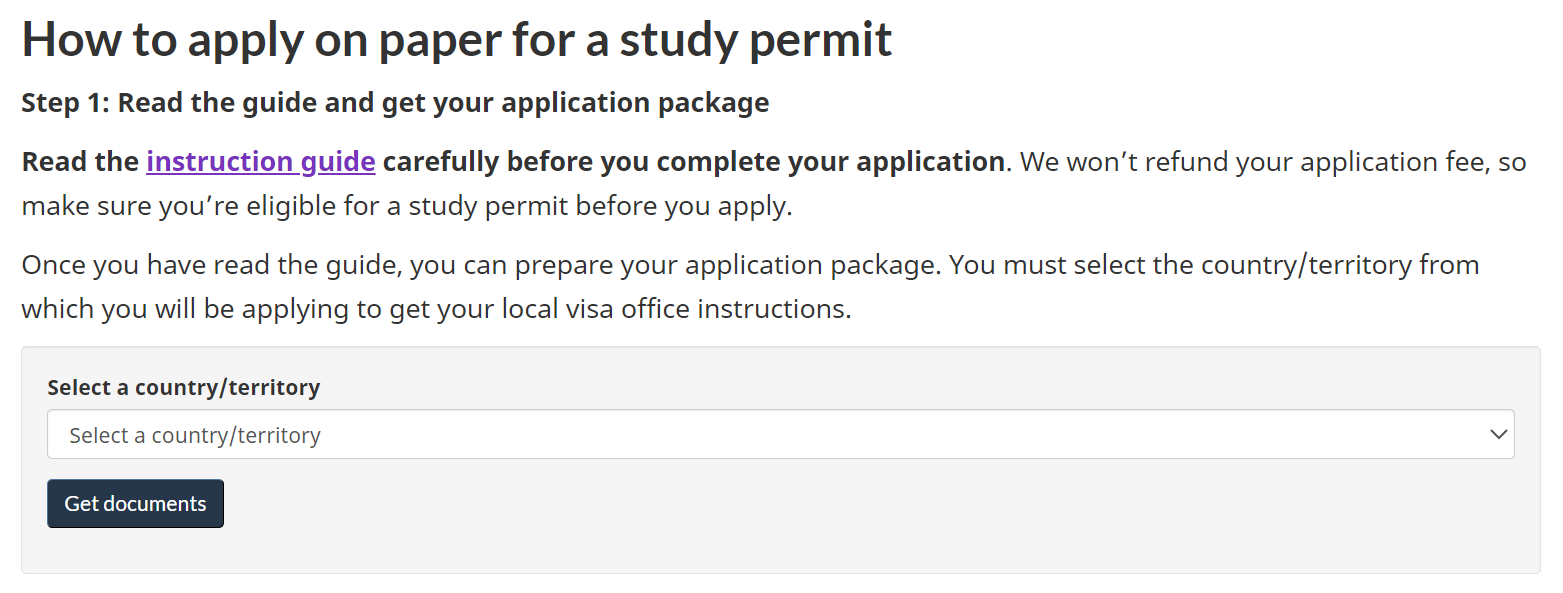
Before applying for your study permit, review IRCC’s [Application Guide](https://www.canada.ca/en/immigration-refugees-citizenship/services/application/application-forms-guides/guide-5269-applying-study-permit-outside-canada.html) and have all the required documents ready. All documents must be provided in English or French \(or accompanied by a certified translation\).
Remember to check the local visa office instructions for additional documents or specifications:
- Visit the [Application to study in Canada page](https://ircc.canada.ca/english/information/applications/student.asp) and select the country you will apply from in the drop-down menu
- Download the document called “Visa Office Instructions”
****
# Required Documents
## Letter of Acceptance \(LOA\)
This letter confirms the details of your intended studies in Canada and is issued by Seneca after you accept your offer of admission and pay your first semester fees. You will receive it by email directly from Seneca. All LOAs are verified by IRCC during the study permit application process. If you receive your LOA through a third party or have concerns about its validity, you should contact theservicehub@senecapolytechnic.ca. In some cases, you may receive a conditional LOA if you have not yet met all admission requirements. Be sure to check your local visa office instructions to confirm whether conditional LOAs are accepted.
## Tuition payment receipt
This document confirms your seat at Seneca and requires you to pay your first semester fees by the deadline indicated in your offer letter. Seneca offers multiple [payment methods](https://students.senecapolytechnic.ca/spaces/96/i-am-an-international-student/wiki/view/1979/payment-methods), and support is available through theservicehub@senecapolytechnic.ca if needed. Once your payment is processed, you can download your [tuition payment receipt](https://students.senecapolytechnic.ca/spaces/96/i-am-an-international-student/wiki/view/1985/downloading-an-official-payment-receipt-for-ircc-purposes) from Student Home.
## Provincial Attestation Letter \(PAL\)
This letter is required for most new study permit applications and confirms that you have been allocated a study space in Ontario. Seneca will request the PAL on your behalf and send it to you by email after you have accepted your offer and paid your first semester fees. Some applicants may be exempt — refer to IRCC for a full [list of exemptions](https://www.canada.ca/en/immigration-refugees-citizenship/services/study-canada/study-permit/get-documents.html#attestation). As with all public institutions in Ontario, Seneca has been allocated a limited number of PALs and therefore cannot guarantee a PAL for all applicants.
## Proof of financial support
You must demonstrate that you have enough funds to cover your tuition, living expenses, supplies and travel for your first year in Canada. Single applicants must demonstrate at least $23,448 CAD for living expenses, with higher amounts required for families \(see [IRCC guidelines](https://www.canada.ca/en/immigration-refugees-citizenship/services/study-canada/study-permit/get-documents/financial-support.html)\). While you only need to prove funding for the first year, visa officers must be confident that you can support yourself throughout your program. It is recommended to show more funds than the minimum. You can refer to your [Seneca program page](https://www.senecapolytechnic.ca/international/programs/list.html) and review the “Costs” tab to estimate your total expenses.
- - - Documents you can use to prove your funds:
- - proof of a student or education loan from a bank
- your bank statements for the past 6 months
- a bank draft that can be converted to Canadian dollars
- proof you paid tuition and housing fees
- a letter from the person or school giving you money
- proof of funding paid from within Canada, if you have a scholarship or are in a Canadian-funded educational program
- proof of a Canadian bank account in your name, if you’ve transferred money to Canada
- a [Guaranteed Investment Certificate \(GIC\)](https://seneca-my.sharepoint.com/personal/heather_macintyre_senecapolytechnic_ca/Documents/Guaranteed%20Investment%20Certificate%20%28GIC%29) from a participating Canadian financial institution
If your country uses foreign exchange controls, you must prove that you’ll be allowed to export funds for all of your expenses.
**Expenses estimate example**: A single applicant from Brazil studying the two-year Early Childhood Education Diploma program at Newnham campus starting in September 2026 should demonstrate the below funds for a study permit application.
**Note**: This calculation is intended as an estimate only and relates specifically to the indicated scenario. Tuition fees vary by program, intake and year. Travel costs also vary by location, season and various other external factors. This is the absolute minimum amount required for the illustrated case.
| **Year 1**
- Tuition: $16,178 (includes pre-paid tuition deposit)
- Health insurance: $934.72
- Ancillary fees: $1,091.60
- Estimated round-trip travel: $900
*Total Funds Required for Year 1: $44,652.32 \(This amount must be readily available\)* |
| --- |
| **Year 2**
- Health insurance: $934.72
- Ancillary fees: $1,091.60
*Total Funds Required for Year 2: $ 44,156.32 \(This amount must be readily available, or you must show that the probability of these funds exists\)* |
- - -
## Letter of Explanation \(Statement of Purpose\)
This letter outlines your reasons for studying in Canada and your overall study plan. It should be written by you, clearly and concisely, and supported with documents included in your application. In your letter, include:
- - - why you want to study in Canada
- - - why you chose your program and Seneca
- - - why you can’t pursue studies in your home country
- - - how studying this program in Canada will advance your career in your home country
- - - how you will pay for your studies
- - - what your plans are after completing your program
- - - a statement saying you understand your [responsibilities](https://www.canada.ca/en/immigration-refugees-citizenship/services/study-canada/study-permit/while-you-study/study-permit-conditions.html) as an international student and will leave Canada at the end of your authorized stay
- - - additional information relevant to your situation
## Proof that you will leave Canada at the end of your stay
As a temporary resident, you must demonstrate that you intend to return to your home country at the end of your authorized stay. Even if you plan to apply for a Post-Graduation Work Permit \(PGWP\) or permanent residence in the future, your study permit application will be assessed based on your temporary intent. You should provide a clear explanation and supporting documents showing strong ties to your home country, such as:
- - - employment or job offer in home country
- - - continuing education in home country
- - - property, residence, or other assets in home country
- - - family ties
- - - community involvement
- - - other obligations or commitments you must return to
## Passport
A valid passport is required. You must provide a copy of the bio-data page \(showing your personal details and passport validity\) as well as copies of all pages with stamps, visas or markings. Most visa offices also require copies of any expired passports you have held. It is important that your passport remains valid for the full duration of your study program and any post-graduation period, as permits cannot be issued beyond your passport’s expiry date.
## Photograph
All applications must include a colour photograph meeting the required [specifications](https://www.canada.ca/content/dam/ircc/migration/ircc/english/pdf/photospecs-e.pdf)
## Other documents as required
Depending on your travel and residence history, and intentions in Canada, you may be required to submit additional documents in your application. It is important to consult the [local visa office instructions](https://ircc.canada.ca/english/information/applications/student.asp) for any further requirements for your region. Additional documents may include:
- - - [police clearance certificate](https://www.canada.ca/en/immigration-refugees-citizenship/services/application/medical-police/police-certificates/how.html)
- - - [medical exam](https://www.canada.ca/en/immigration-refugees-citizenship/services/application/medical-police/medical-exams/requirements-temporary-residents.html) - If you intend to work in a healthcare of childcare setting you must complete an [immigration medical exam \(IME\)](https://www.canada.ca/en/immigration-refugees-citizenship/services/application/medical-police/medical-exams/requirements-temporary-residents.html) and include this in your application
- - - Guaranteed Investment Certificate \(GIC\)
- - - [language test result](https://www.canada.ca/en/immigration-refugees-citizenship/services/study-canada/study-permit/student-direct-stream/eligibility.html#tests)
- - - previous academic records
- - - CV/resume
- - - proof of employment
- - - [custodian declaration](https://www.canada.ca/en/immigration-refugees-citizenship/services/study-canada/study-permit/get-documents.html#doc6) \(minor children\)
[**Next step – How to apply >>**](https://students.senecapolytechnic.ca/spaces/96/i-am-an-international-student/wiki/view/13652/3-how-to-apply)
## Attachments
- [image_39390265281710257865763.png](https://students.senecapolytechnic.ca/attachment?file=%252FEfWYtJw5hmMU%252FZroYR3BQ%253D%253D)